The Future of Work with AI Agents: What Do Workers Really Want?

Martín Marlatto
CSO at WillDom | Partner
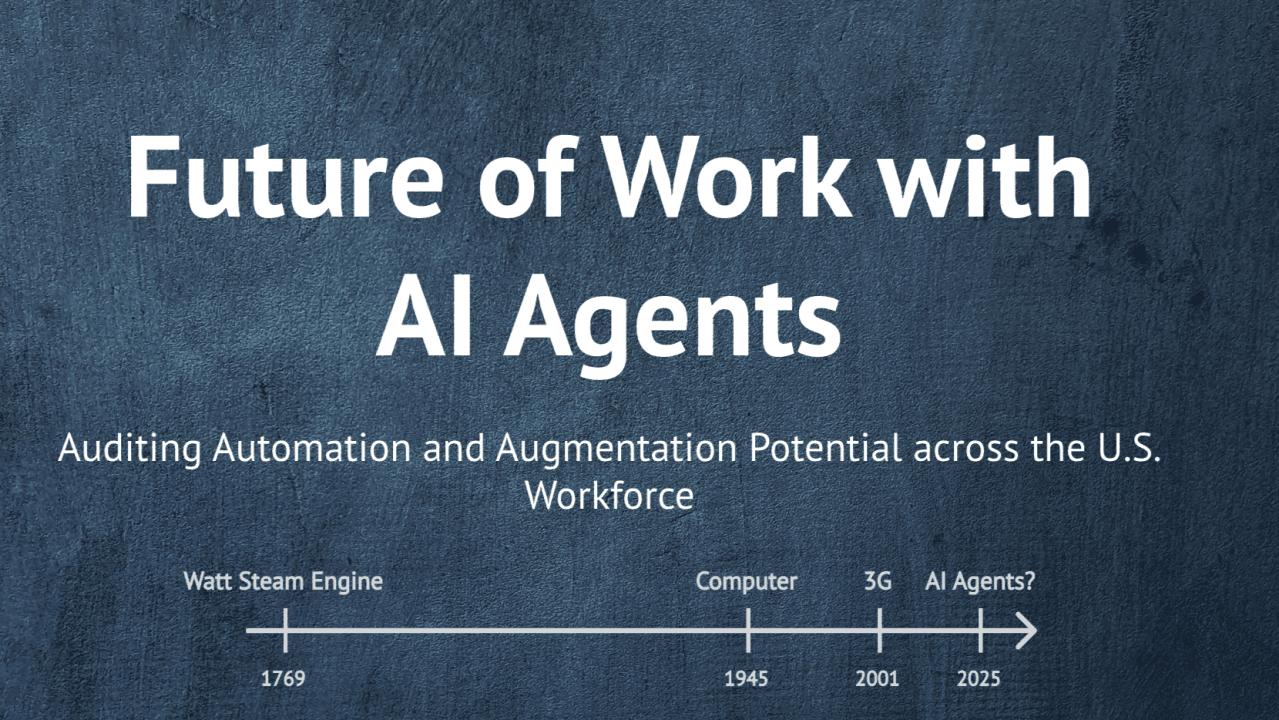
AI is rapidly changing the landscape of work, but are we asking the right questions about how it should be integrated? A fascinating new study from Stanford, "Future of Work with AI Agents: Auditing Automation and Augmentation Potential across the U.S. Workforce," dives deep into this topic—and the findings are eye-opening.
What's Different About This Research?
Instead of just looking at what AI can do, the authors focused on what workers want AI to do. They surveyed 1,500 workers across 104 occupations and paired their insights with assessments from 52 AI experts. The result? A nuanced understanding of how AI agents (goal-driven systems powered by LLMs) could automate or augment real-world tasks.
Key Takeaways
Not All Automation Is Welcome
Workers are eager for AI to take over repetitive, low-value tasks. As the paper puts it:
"For 46.1% of tasks, workers express positive attitudes toward AI agent automation, even after reflecting on potential job loss concerns and work enjoyment. The primary motivation for automation is freeing up time for high-value work, though trends vary significantly by sector."
Human Agency Matters
The study introduces the Human Agency Scale (HAS), a five-level framework that measures how much human involvement is needed—or desired—for different tasks.
"Our framework expands beyond the binary view of automation. We propose the Human Agency Scale (i.e., H1-H5)… quantifying the degree of human involvement required for occupational task completion and quality."
Most workers don't want to be replaced; they want AI to act as a partner, not a boss.
Mismatch Between Desire and Investment
"41.0% of Y Combinator company-task mappings are concentrated in the Low Priority Zone and Automation 'Red Light' Zone. Current investments mainly center around software and business analysis, leaving many promising tasks within the 'Green Light' Zone and Opportunity Zone under-addressed."
Skills for the Future
As AI takes on more information-processing tasks, the human edge will shift toward interpersonal and organizational skills.
"Traditionally high-wage skills like analyzing information are becoming less emphasized, while interpersonal and organizational skills are gaining more importance."
Why Does This Matter?
If we want AI to truly empower the workforce, we need to consider not just what's possible, but what's desirable. Aligning AI development with worker preferences can help us avoid resistance, boost adoption, and create more positive outcomes for everyone.
Final Thought
The future of work shouldn't be about humans vs. machines—it's about building better partnerships. If you're involved in AI, HR, or workforce strategy, this study is a must-read.
Source: Future of Work with AI Agents